| 1.
Accountability
Responsibility for the use of resources and the decisions made, as well
as the obligation to demonstrate that work has been done in compliance
with agreed-upon rules and standards and to report fairly and accurately
on performance.
2. Activity
Actions taken or work performed through which inputs such as funds, technical
assistance, and other types of resources are mobilized to produce specific
outputs.
3. Assumptions
Hypotheses about factors or risks which could affect the progress or success
of a program/project. These assumptions are often factors beyond the control
of the program/project management.
4. Attribution
To establish a causal link between observed changes and a specific program/project.
5. Audit
An independent, objective quality assurance activity designed to add value
and improve an organization’s operations. It helps an organization
accomplish its objectives by bringing a systematic, disciplined approach
to assess and improve the effectiveness of risk management, control and
governance processes.
Note: Internal auditing is conducted by a unit reporting to management,
while external auditing is conducted by an independent organization.
6. Baseline
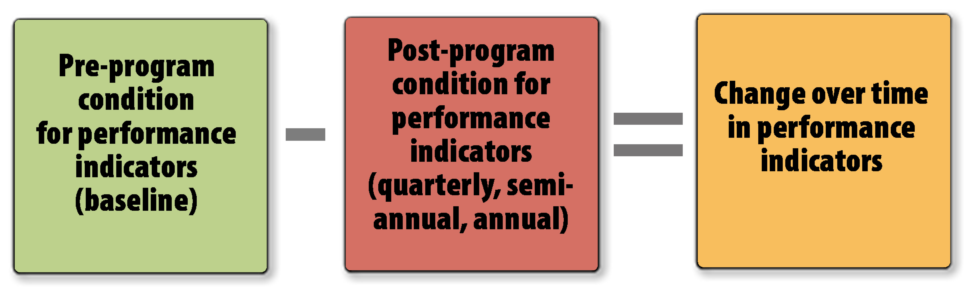
Defines the pre-implementation condition of a program/project. Comparing
performance indicator data to the baseline reflects a “change over
time”.
7. Benchmark
A reference point or standard against which performance or achievements
can be assessed.
Note: A benchmark refers to the performance that has been achieved in
the recent past by other comparable organizations, or what could reasonably
be achieved in similar circumstances.
8. Beneficiaries
The individuals, groups, or organizations, whether targeted or not, that
benefit directly or indirectly, from a program/project.
9. Beneficiary Contact Monitoring (BCM)
Is a systematic investigation to monitor beneficiaries’ –
women’s, men’s, girls’ and boys’ – perceptions
of an intervention, it
• Focuses on beneficiary access to, use of and satisfaction with
outputs by seeking feedback directly from the women, men and children
who are the target group for an intervention.
• Concerns the transition between outputs and outcomes.
• Provides managers with an indication of progress towards the achievement
of an intervention’s outcomes.
• Uses a variety of techniques and data collection methods.
10. Conclusions
Highlight the factors of success and failure of the program/project, with
special attention paid to the intended and unintended results, and more
generally to any other strength or weakness. Routine data collection and
analysis are used to support conclusions.
11. Coverage
The extent to which a program/project is being implemented in the right
places (geographic coverage) and is reaching its intended target population
(individual coverage).
12. Data
Specific quantitative and qualitative information or facts that are collected
and analyzed.
13. Goal / Impact
Refers to the sectoral or national objectives towards which the activity
is designed to contribute, e.g. increased incomes, improved nutritional
status, reduction in crime. The goal helps set the macro-level context
within which the activity fits, and describes the long-term impact that
the activity is expected to contribute towards (but not achieve by itself).
14. Goal
A broad statement of a desired, usually longer-term, outcome of a program/project.
Goals express over-arching intentions and help guide the development of
a program/project objectives and activities.
15. Impact
The positive and negative changes produced, directly or indirectly, as
the result of a program or project
16. Impact evaluation
An evaluation that assesses the rise and fall of impacts, such as disease
prevalence and incidence, as a function of HIV programs/interventions.
Impacts on a population are rarely attributabled to a single program/intervention.
17. Indicator (also performance indicator,
or key performance indicator)
Indicators are at the heart of monitoring and evaluation, they provide
a simple and reliable means to measure achievement, to reflect the changes
related to a program/project, or to help assess the performance that is
used to demonstrate change. Monitoring is generally carried out on a set
of key performance indicators (KPIs) on a periodic basis (quarterly, semi-annual,
annually) and the information is used to measure progress towards the
achievement of targets, which will then be periodically compared against
baseline.
Performance indicators may measure outputs or outcomes. Output indicators
are used to assess whether and to what extent outputs have been delivered.
Outcome indicators are used to assess whether, or the degree to which
the expected outcomes have occurred.
Indicators and Data — So, what's the
difference?
Indicators define the particular characteristic or dimension that will
be used to measure change. Height is an example of an indicator. The data
are the actual measurements or factual information that result from the
indicator. Five feet seven inches is an example of data.

18. Impact monitoring
Positive and negative, primary and secondary long-term effects produced
by a development intervention, directly or indirectly, intended or unintended.
In the field of public health, impact monitoring is usually referred to
as “surveillance”, which involves tracking of health-related
events, such as the prevalence or incidence of a particular disease.
19. Incidence
The number of new cases of a disease that occur in a specified population
during a specified time period.
20. Inputs
The financial, human, and material resources used in program/project implementation.
21. Input and Output monitoring
Tracking of information on program/project inputs (i.e., resources used
in the course of implementation) and program/project outputs (i.e., results
of the activities).
22. Intervention
A specific activity or set of activities intended to bring about change
in some aspect(s) of the status of the target population (e.g., HIV risk
reduction, improving the quality of service delivery).
23. Lessons learned
Generalizations based on evaluation experiences with programs, development
interventions or policies that abstract from the specific circumstances
to broader situations. Frequently, lessons highlight strengths or weaknesses
in preparation, design, and implementation that affect performance, outcome,
and impact.
24. Logical framework
Management tool used to improve the design of interventions. It involves
identifying strategic elements (inputs, outputs, activities, outcomes,
impact) and their causal relationships, indicators, and the assumptions
of risks that may influence success and failure. It thus facilitates planning,
execution, and monitoring and evaluation of an intervention.
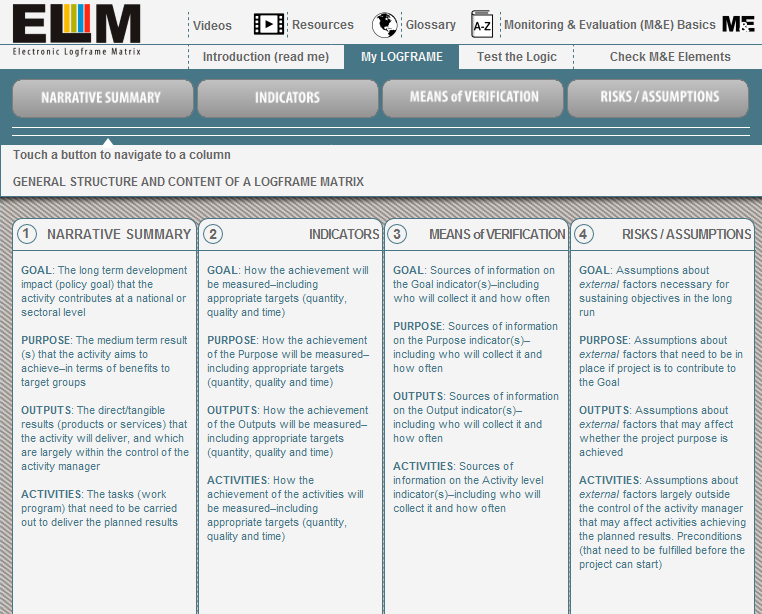
Electronic Logframe Matrix (ELM)
Most multilateral donor organizations will likely provide a custom logframe
template in their own preferred format, which is often not modifiable
and presents a rigid framework against which performance is assessed.
In such instances, logframes begin to resemble an accounting rather than
a program design tool. If the donor does not provide a custom logframe
template, as a starting point, try the electronic
logframe matrix (ELM), which vastly simplifies the process of generating
logframes.
25. Meta-evaluation
A type of evaluation designed to aggregate findings from a series of evaluations.
It can also be used to denote the evaluation of an evaluation to judge
its quality and/or assess the performance of the evaluators.
26. Monitoring
The collection of routine data that measure progress toward achieving
program/project objectives. Monitoring is used to track changes in performance
over time..
27. M&E plan
A multi-year implementation strategy for the collection, analysis and
use of data needed for program/project management and accountability purposes.
The plan describes the data needs linked to a specific program/project;
the M&E activities that need to be undertaken to satisfy the data
needs and the specific data collection procedures and tools; the performance
indicators for which data need to be collected; the components of the
M&E system that need to be implemented and the roles and responsibilities
of relevant organization / individuals in their implementation; how data
will used for program / project management and reporting. The plan indicates
resource requirement estimates and outlines a strategy for resource mobilization.
28. M&E work plan
An annual costed M&E plan that describes the priority M&E activities
for the year and the roles and responsibilities of organizations / individuals
for their implementation; the cost of each activity and the funding identified;
a timeline for delivery of all products / outputs. The work plan is used
for coordinating M&E activities and assessing progress of M&E
implementation throughout the year.
29. Objective
A statement of a desired program/intervention result that meets the criteria
of being Specific, Measurable, Achievable, Realistic, and Time-phased
(SMART).
30. Outcome
Short, and medium term outputs of activities, such as change in knowledge,
attitudes, beliefs, behaviors.
31. Outcome Evaluation
A type of evaluation that determines if, and by how much, intervention
activities or services achieved their intended outcomes. An outcome evaluation
attempts to attribute observed changes to the intervention tested.
32. Outcome Monitoring
Involves tracking of variables that have been adopted as valid and reliable
measures (i.e., indicators) of the desired program/intervention outcomes.
Outcome monitoring does not infer causality; changes in outcomes may be
attributable to multiple factors, not just a specified program/intervention.
Note: With national AIDS programs,
outcome monitoring is typically conducted through population-based surveys
(i.e., representative of the target population, not necessarily the general
population).
33. Outputs
The results of program/project activities; the direct products or deliverables
from activity implementation, such as the number of HIV counseling sessions
completed, the number of people served, the number of condoms distributed.
Outputs vs Outcomes
Outputs are the direct result of implementation of activities. Outputs
are typically tangible, and measurable immediately following the completion
of an activity.
For example: We conduct intensive
coaching sessions to prepare students for the national exam next year.
The number of students who participate in the sessions would be the output
of our activity.
Outcomes are typically intangible, and measurable
in the medium to long term.
For example: We conduct intensive
coaching sessions to prepare students for the national exam next year.
Immediately following each session, we tally the number of participants,
which represents our output. However, since the national exam is not until
next year, we can not immediately know the outcome of our efforts. In
effect, the outcome of our activity would be the number of students who
received intensive coaching, and went on to pass the national exam.
So we develop our output and outcome indicators
Output indicator (for which we will
collect data following each training session, then aggregate / disaggregate
and report each quarter)
Number of students who received intensive coaching during the reporting
period
Outcome indicator
Number of students who received intensive coaching, and passed the national
exam
Outcomes are typically intangible and harder to measure, given that in
our example, our intensive coaching sessions may not have been the sole
contributing factor to students passing the national exam. For instance,
students may also have been receiving additional coaching at home!
34. Performance
The degree to which a program/project or organization operates according
to specific criteria/standards/guidelines or achieves results in accordance
with stated objectives or plans.
35. Process Evaluation
A type of evaluation that focuses on program/intervention implementation,
including, but not limited to access to services, whether services reach
the intended population, how services are delivered, beneficiary contact
monitoring, management practices. In addition, a process evaluation might
provide an understanding of cultural, sociopolitical, legal, and economic
contexts that affect implementation of the program/intervention.
36. Program
A program generally includes multiple activities intended to achieve a
specific set of global, regional, country, or sub-national objectives;
the activities may cut across sectors, themes and/or geographic areas.
37. Project
An intervention designed to achieve specific objectives within specified
resources and implementation schedules, often within the framework of
a broader program.
38. Qualitative Data
Data collected using qualitative methods, such as interviews, focus groups,
observation, and key informant interviews. Qualitative data can provide
an understanding of social situations and interaction, as well as people’s
values, perceptions, motivations, and reactions. Qualitative data are
generally expressed in narrative form, pictures or objects (i.e., not
numerically).
39. Quality Assurance
Planned and systematic processes concerned with assessing and improving
the merit or worth of an intervention or its compliance with given standards.
Note: Examples of quality assurance activities include appraisal, results
based management reviews, evaluations.
40. Quantitative Data
Data collected using quantitative methods, such as surveys. Quantitative
data are measured on a numerical scale, can be analyzed using statistical
methods, and can be displayed using tables, charts, histograms and graphs.
Note: The aim of a quantitative study is to classify features, count them,
and construct statistical models in an attempt to explain what is observed.
41. Relevance
The extent to which the objectives, outputs, or outcomes of a program/project
are consistent with beneficiaries’ requirements, organizations’
policies, country needs, and/or global priorities.
42. Reliability
Consistency or dependability of data collected through the repeated use
of a scientific instrument or a data collection procedure used under the
same conditions.
43. Research
A study intended to generate or contribute to generalizable knowledge,
for instance, to improve public health practices. Research typically attempts
to make statements about how the different variables under study, in controlled
circumstances, affect one another at a given point in time.
44. Results
The outputs, outcomes, or impacts (intended or unintended, positive and/or
negative) of a development intervention.
45. Results based management (RBM)
A management strategy focusing on performance and achievement of outputs,
outcomes and impacts.
46. Stakeholders
Agencies, organizations, institutions, entities, groups and individuals
who influence or are directly or indirectly influenced/affected by a program/project
can be defined as stakeholders. Stakeholders have a significant interest
in the success or failure of a program/project. The involvement of the
largest possible number of stakeholders in the management of a program/project
cycle (planning, implementation, evaluation, reporting) will promote understanding,
encourage ownership, and foster sustainability.
47. Sustainability
Describes the process of continued existence of benefits from a program/project
after the implementation has been completed. Sustainability is the primary
aim of development interventions. A program/project is sustainable if
the changes purposely set in motion and supported (effects, processes,
etc.) during implementation can be continuously developed post-implementation.
48. Target
The objective a program/project is working towards, expressed as a measurable
value; the desired value for an indicator at a particular point in time.
49. Target group
Specific group of people who are to benefit from the implementation of
a program/project.
50. Triangulation
The analysis of data from three or more sources obtained by different
methods. Findings can be corroborated, and the weakness or bias of any
of the methods or data sources can be compensated for by the strengths
of another, thereby increasing the validity and reliability of the results.
51. Validity
The extent to which a measurement or test accurately reflects what it
was intended to measure.
|




